

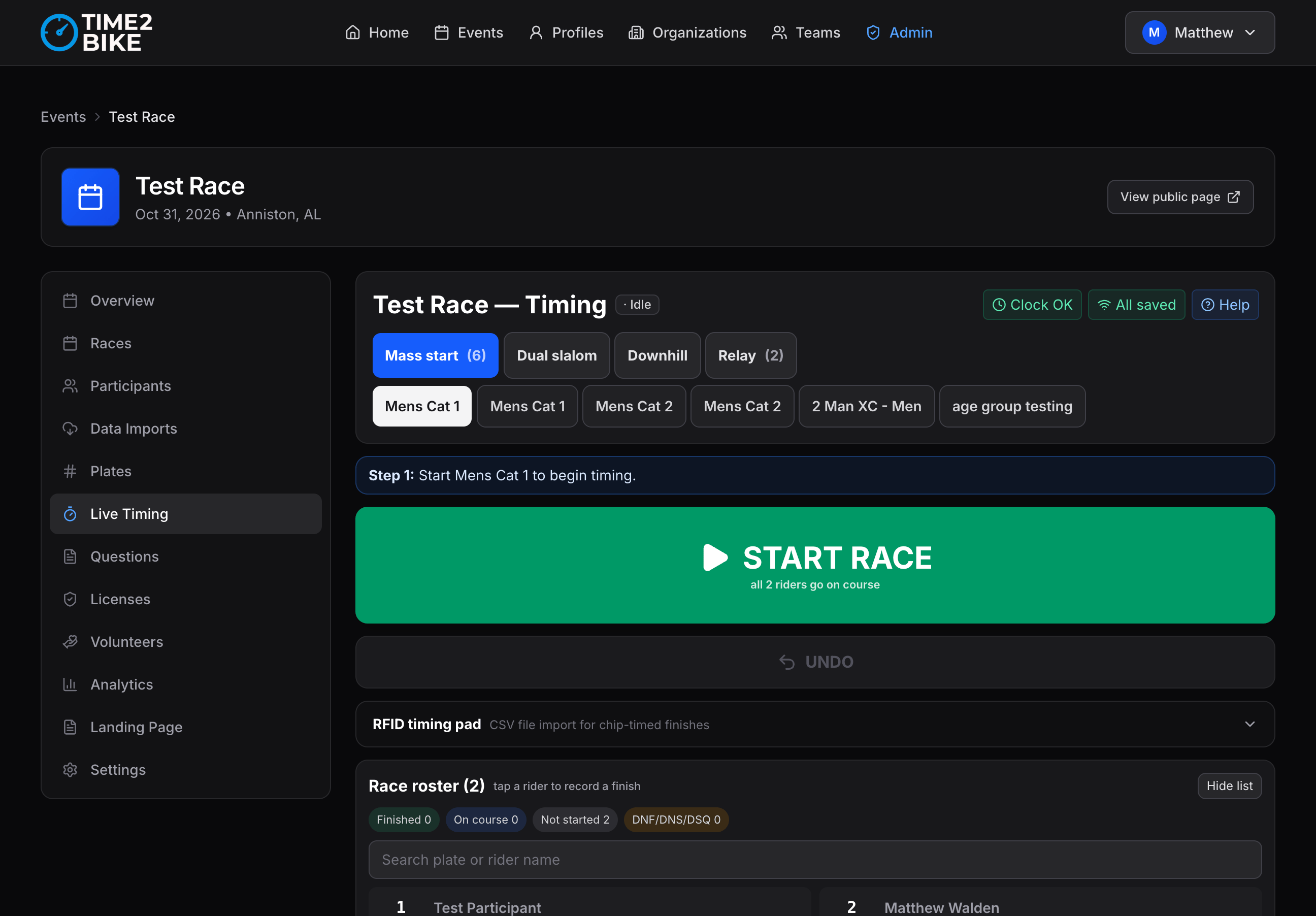
!!-IMAGE-NEEDED-!! — The full timing screen with callout numbers on each region described below.
Top bar
The blue hint bar
A one-line prompt telling you what to do next — Step 1: Start Cat 3 Men to begin timing, then Step 2: Enter a plate number or tap a rider. It follows the state of the race, so if you’re not sure what to do, read that line.The race board
A panel at the top listing every race in the event and what it’s doing right now — running with a live clock, stopped with a finisher count, or not started.!!-IMAGE-NEEDED-!! — The race board with three races running and one not started.
- The header says 3 of 5 races running, so you never have to click through tabs to find out what’s live.
- Start or stop any race from here, without leaving the one you’re recording into.
- Tap a race name to switch to it. The row you’re recording into is badged recording, and defers to the big buttons below rather than offering a second set.
Start / Pause / Stop
Big buttons for the race you’re recording into, sized for cold hands.- START RACE — opens the clock. The label underneath tells you what pressing it actually does to the field: all 47 riders go on course, or riders go on course as you check them in.
- Pause / Resume — labelled Freeze clock or Pause entries depending on how the timer is set. Freezing stops everyone’s elapsed time (a real course hold); pausing entries just stops recording while the clock runs on.
- STOP — ends the race. You can still fix everything afterwards.
- Set the start time — the small button under the grid. Puts the start at a time you type off the clock instead of the moment you press a button, for a race that went while nobody was at the screen. Once a race is running the same button reads Correct the start time.
The big number box
The single most important control. Type a bib, press Enter.- It stays focused, so you don’t have to click it before typing.
- As you type, matching riders appear as chips — tap one instead of finishing the number.
- There’s an on-screen digit pad for gloved hands and touchscreens.
- An UNDO button sits next to it. One tap reverses your last recording.
On course
Riders who’ve started but not finished, sorted by elapsed time. This is your “who’s still out there” list, and at the end of a race it’s your DNF list.Registered riders
The full roster for the selected race. Tap any name to record them right now — what you reach for when a bib is unreadable or caked in mud. There’s a search box, and the list collapses automatically for big fields so the timing controls stay above the fold.Any result row
Tap a row to open its menu: manual time, DNF/DNS/DSQ, add a note, record a split, void a lap, delete. What you see depends on your access level. → CorrectionsTimer setup
One button below the rider lists opens Timer setup — every setting for this timer, in one panel with three sections.!!-IMAGE-NEEDED-!! — The Timer setup panel open on the “How I am timing” section.
Setting up several races at once
Five criterium categories usually want identical settings, and doing them one at a time is how the fourth ends up different. Tick as many races as you like — or All races — and set them together. Two rules keep that safe:- Only what you change gets written. Anything you don’t touch is left exactly as it is on each race. Selecting five races and editing the lap count won’t flatten their timing points.
- Where the selected races disagree, the field shows
mixedand stays that way until you set it. Nothing picks a value on your behalf.
Settings used to be spread across four surfaces, including a button called
“Configure default lap mode (fallback)” that held finish style and display
precision. If you’re looking for something from an older screenshot, it’s in
here.
Footer
Inside More actions
Worth knowing what’s in there before you need it:Download for offline
Download for offline
Saves the timing screen onto this device so it opens with no signal at all.
Do this the day before if you’re racing somewhere remote.
Add riders
Add riders
Enter a drop-in by bib, name, and team without them registering. Works
offline. → Adding riders
Exports and printing
Exports and printing
CSV, JSON, printed results, per-race PDF, whole-event PDF, whole-event CSV.
Printing and the CSV/JSON exports work offline.
→ Exports
Operator tokens
Operator tokens
Create and revoke volunteer links.
→ Volunteer links
Record prime
Record prime
Award a mid-race prime to a rider on a given lap.
→ Laps & primes
Import results
Import results
Pull results in from another timing platform’s file.
Reset timing data
Reset timing data
Wipes timing for one race or the whole event and starts over. There’s a
confirmation, and it’s blocked while anything is still waiting to upload.
Use it after a test run.
Next
Recording points
Telling the screen where on the course you’re standing.
Corrections
Fixing what goes wrong.